
Do bamboo pillows have health benefits?
Bamboo has become the most important trend that is part of the trend of big companies and brands, looking for ways to make the production and use of environmentally friendly materials. With the aim of reusing the materials and trying to reduce the pollution they create. Part of the ambition is to make use of consumables. Bamboo is one of the materials that on the one hand does not harm the earth and on the other hand is a perishable material. The use of hemp reduces water consumption by 2/3 compared to the use of cotton.
Bamboo is everywhere these days. You can find baby clothes, soft and comfortable bedding, bamboo pillows, towels and not only in textiles, you can find bamboo in the kitchen, furniture for the house and furniture for the garden. In Asia, the use of bamboo is more widespread, and can also be found in scaffolding of buildings, building materials and more. The advantage of bamboo is that it grows quickly.
What exactly is a bamboo pillow?
A bamboo pillow is made in part of bamboo masses, it is a crushed mixture of bamboo leaves, from which the fabric is made, the bamboo part of the pillow is in the shell, and not in the stuffing.
Why buy a bamboo pillow?
Some online sources claim that fabrics made from bamboo are naturally soft, durable and breathable.
It is claimed that bamboo is hypoallergenic. Bamboo is less likely to cause an allergic reaction compared to other materials. Which is very important in a baby.
There is not much solid research on the health benefits of bamboo pillows. But there is evidence that bamboo fibers – those used in bamboo pillows – have many of the qualities spoken of online.
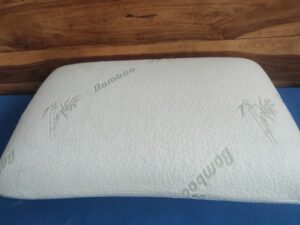
Health benefits
Compared to other types of fabrics such as cotton, which are used to make pillows, bamboo may be better at keeping an old sleeping head cool and dry. Because the bamboo plant fibers are hollow, the holes in the bamboo fibers absorb moisture, allowing hot air to escape. Hence a bamboo fabric that naturally evaporates moisture and heat.
Bamboo may be hypoallergenic and antibacterial. Evidence can be found that bamboo fibers are naturally resistant to bacterial growth. This means that they are less likely to store microorganisms that can lead to smelly diseases or odors. But on the other hand there are studies that have examined bamboo and have not found it to be more antibacterial than cotton.
Soft and non-static bamboo fabrics. Bamboo fibers are anti-static and anti-stick. Hence they also tend to be softer and more glossy similarly, except for silk and cashmere.
Compared to cotton, bamboo fabrics are easier to handle, as bamboo materials are more washable and less wrinkled and less prone to shrink in laundry.
Bamboo also grows faster than most plants. Unlike trees that have to be cut down for at least 25 years, bamboo grows fast, it also grows in soil that is poor in materials and no food can be grown in it, in addition it does not need much water for irrigation, in most cases it grows in tropical springs. The bamboo is easily degradable. Unlike many other crops, bamboo does not need pesticides.
Bamboo can be environmentally friendly and have important environmental benefits, it decomposes quickly compared to trees, bamboo absorbs much more carbon dioxide – greenhouse gas – and creates more fresh oxygen.
Products made of bamboo, pillows, sheets, baby clothes and more. Will contribute to the preservation of the world, and will contribute to the best feeling for its users, but it is important to remember that so far no study has been conducted comparing the health benefits of bamboo pillows to pillows made of other materials.